Showing posts with label Bornean orang utan. Show all posts

Sunday, 30 June 2013

A Quick Visit to Paignton

JUST A FEW SUBJECTS THIS TIME

25th June 2013

I didn't have a full day on my latest visit to Paignton, but I wanted to see the baby Bornean orang utan born to Mali on the 11th of April (two weeks after my previous visit).
Unfortunately Mali was on the large orang island in the morning and she spent the time so deep in the vegetation that I could hardly see her, let alone her daughter. Fortunately I was on the viewpoint when the keepers called her back to the house for a snack of fruit. She climbed up to the entrance door (which was locked so that another orang could use the indoor area). She sat and enjoyed her titbits between the plastic draught excluders, which gave me the opportunity for an extended sequence.

My original photos showed a lot of the plastic screens. I tried cropping to a square format, but I liked the facial expressions of both apes so much that I thought a pair of portrait crops might work better. This took a little more work in Photoshop, but I like the results.


You just have to love baby orangs! I am also very pleased that Mali is such a good mother.

My other subject was the old short-beaked echidna, the only monotreme in the UK. He was taking a constitutional before his afternoon feed. The dappled sunlight in his enclosure was very attractive, but a photographic nightmare. The old guy trundles around his enclosure on his habitual paths and it doesn't look as if he is moving fast: but any photos shot at less than 1/200 s are quite blurred, unless you can catch a rare still moment. Neither of these shots are perfect, but both show him quite well.


I just had time to catch the gorilla keeper's talk at 2.30pm. There were so many people around her that I couldn't use my camera. But I walked a few metres further and spotted my favourite gorilla waiting on one side in the shade. He was keeping out of trouble as he is the youngest male in the group.
Matadi is the great great grandson of Stefi and Achilla, the first gorillas to breed in Europe. I photographed them at Basel forty years ago. I have images of all the gorillas in Matadi's family tree since then, except for his late father Sekondi, who always disappeared when I had my camera. Matadi is now a well grown blackback and I don't think it will be too long before he is moved to a zoo where he can meet some females as he is not closely related to any other gorillas in the Studbook so his genes are important.


Thursday, 27 June 2013

Another Chester Visit

A HAPPY WANDERER

16th June 2013

When I visit a zoo, I may have a specific target in mind, but often I just wander round without much planning: on the other hand, as I visit my favourite zoos quite frequently I do know a little about the most likely times and places for photo opportunities. However you should always be prepared to learn by watching for new opportunities.
Sunday June 16th did not have a brilliant weather forecast, but cloudy skies can work well for photography and I hoped to get a chance to see the new tiger cubs born on the 3rd of June.
I always start at the Islands in Danger building, as my favourite Boelen's pythons are most active early in the day. After working out with a few fairly unsuccessful shots, I made my way to the tigers before things got too busy.
Kirana, the female Sumatran tiger, had taken given birth in her indoor quarters; but she had followed the pattern of her previous two litters and moved the cubs to her favourite den, under a wooden platform quite near to both the ground level viewing window and the high level viewing platform for visitors. She seems content to let Fabi, their father, stay in the same enclosure provided that he soesn't get too close to the den.  Unfortunately being quite near to visitors does not mean that the cubs are easy to see. The angle of the platform and the thick planting of the enclosure means that viewers and photographers are very restricted in what they can see. I was lucky to get a few shots with my 500mm as one of the cubs was crawling at the edge of the den while Kirana was feeding the other. This is the best one.
  
I returned to the tiger enclosure several times during the day, without seeing the cubs again.
On my last visit I saw the two banteng cows in their new enclosure near the old entrance (the former wapiti/bongo paddock). This time they had managed to move the bull in with them and both cows had given birth to calves as well. The bull is an impressive animal.


Both the Javan banteng and the Sumatran tigers are due to be moved into the new Islands exhibit which is now being developed south-east of the current zoo boundary.
The zoo has had a pair of Linne's two-toed sloths in the Jaguar house for about a year now. I haven't been really happy with any of my sloth photos so far, but I keep trying. The light indoors is not really good enough to use my 500mm lens, but I tried as an experiment: although this shot needed some work with Capture NX2 and Photoshop and there are some out of focus twigs which degrade the image, I like the pose and the countershading - so I rate it a qualified success.


At Realm of the Red Ape (generally known as RotRA) the Sumatran orang utans were not very visible, but the Bornean group was showing well. They had just been given access to their second outdoor cage, which had been temporarily occupied by the small-clawed otters. This had allowed the shrubs to put on some growth, so the orangs had plenty of pruning to do - they are remarkably destructive. Old Martha was happily consuming a small bamboo - she is about 48 and one of the oldest orangs in the UK. She sometimes appears rather stiff, but she is still active and climbs well.

Martha lives with her daughters Sarikei and Leia, and her 4 year old grandchildren Iznee and Latifah who are delightfully active. Tuan, the adult male cannot be mixed with the group and he is normally kept off-show. At the moment Chester are also boarding Blackpool Zoo's group of Bornean orangs while their house is being rebuilt, but they have also been off-show when I have visited. I was pleased to take the portrait of Martha, although I wish it were a little sharper; the one of Latifah below is better, because I was able to get the lens perpendicular to the window that I was shooting through.


There is no problem with glass at the Chimp Island, a group were close to the moat near RotRA. This is Carlos, a subadult male who is one of the youngest in the group.


When I was a boy, there were three ape islands just covered with grass. Now there is one large island  furnished with telegraph poles and nets for climbing and thickly planted with shrubs. This doesn't just look attractive, it gives the chimps opportunities to join up in small groups or to stay away from each other and to find interesting plants to investigate. This older lady, who might be Heidi (but I'm not sure), was enjoying the flowers and young leaves of a wild rose.


My path went from the chimps, past the macaws and through the Tropical House. I always check the tuataras near the door by the main entrance. They are great rarities in zoos, and although they not particularly spectacular or active, they are fascinating. One of the females was posing at the mouth of her burrow.

In the afternoon the light is favourable in the Tsavo aviary. The black-headed village weavers are the most obvious birds. The males are building their nests, displaying or destroying other nests. Females are less flamboyant but they watch what is going on and flutter their wings to encourage males which catch their eyes.

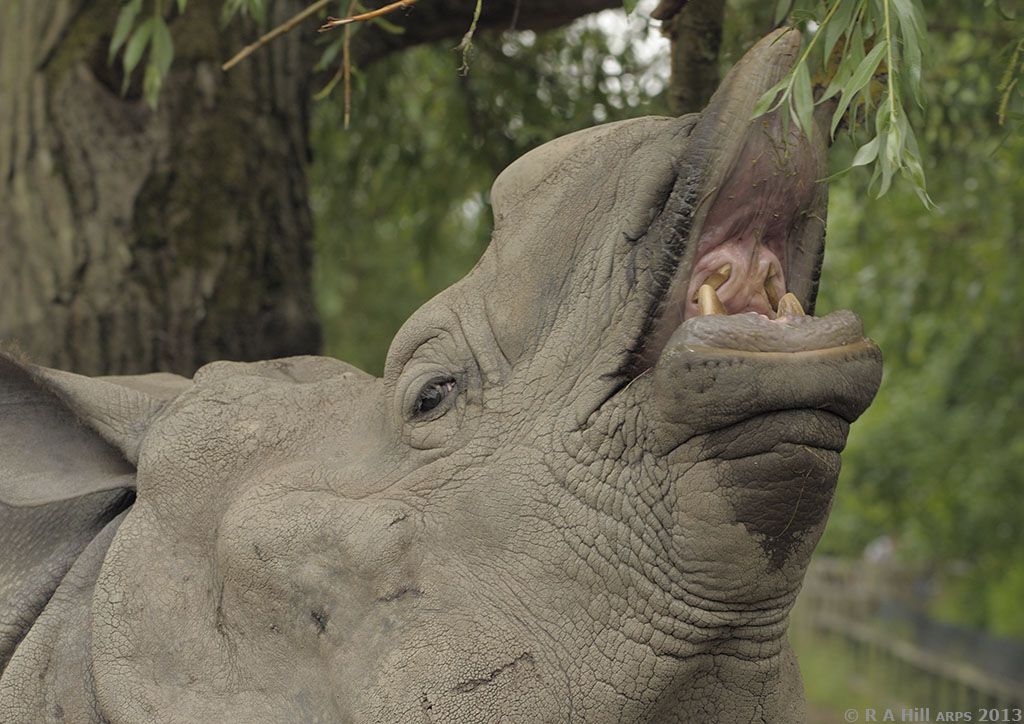
The Indian rhinos were active as I headed back to the tigers again. Asha was in the pool and the bull Beni was showing off close to the ditch. I switched to my 105mm lens for this shot as he sampled a few willow leaves. Impressive teeth!


Finally as the zoo went quiet at closing time, I did a quick tour of the aquarium. I have never seen one of the young Annam leaf turtles out of the water before, so I was very pleased to catch this pose which was perfect for my 105mm macro. The zoo has done well with this species and several other very rare terrapins, most of which are off-show. The zoo is planning a new turtle exhibit too.


Monday, 4 March 2013

Paignton Zoo


 My first full zoo photography day of 2013


I like zoos, provided that they are good zoos. I enjoy watching interesting animals and I like the chance to photograph them. Zoo photography is a good deal easier than photography of truly wild animals, but many of the skills are the same, so a zoo visit provides excellent practice. When I get a new piece of photographic kit, I take it to a zoo to get plenty of opportunities to learn how to use it effectively.
I like Paignton Zoo: it has some of my favourite animals and it generally does things the right way. Most of the enclosures are attractive and the zoo is a pleasant place to visit (unless you let the herring gulls see your packed lunch).
My first stops are usually Reptile Tropics and the Desert House. On the 17th of February, the hooded parakeets in the Desert House caught attention. The male’s colours of black, vivid cyan and bright yellow ought to clash horribly – but actually they combine wonderfully well. He was feeding one of the hens and she was inspecting nest boxes, which was a good sign. The Desert House is large and the hoodeds are fairly small, so I chose to add my 1.4x converter to my 500 mm lens as the light was good. I needed patience to get a really good opportunity.


I find that this 700 mm lens combination is usually too long for zoo work, but an unfamiliar view can be stimulating and I thought it might work well at the Ape Centre. Gorillas are my favourite zoo animals and orang utans are not far behind. I am not too fond of the house, but the outdoor enclosures are very good; they are effectively islands in the bottom of a small valley, from the ape’s point of view they are spacious and well vegetated. Visitors can usually see the animals doing interesting things, but only from a few vantage points. I spotted Chinta, the oldest female orang, on her favourite perch which was just right for my long lens.

Chinta is an unsociable animal, which is quite normal for an adult orang. She is usually kept on her own, although I hope that she will soon be able to mate with Demo, the zoo’s young male orang. As I watched she felt the need for a snack and clambered down to find a little something. I quickly moved back down the pathway to get a clear view of the whole tree while she chose a twiggy branch with tender bark.

Some of the gorillas came outside for a lunchtime scatter feed, so I moved to the viewing point between the islands. I think it was N’Dowe who decided to sit in the sun. After eating a couple of onions, he decided to practise his chest-beating display. I had never managed to photograph this display before, it is unpredictable because the its impact is mainly due to its surprise quality. N’Dowe did take me by surprise first off, but I could see he was working himself up again (as a chimp might do before displaying) and I increased the shutter speed and watched him carefully through the viewfinder. This is the climax of his third attempt.

After visiting the bird section, I replaced my long lens with my 105 mm macro (the only other lens I had with me). As I headed back towards the entrance, a crested seriema posed in a patch of sunlight in the Brook Side Aviary: too good an opportunity to miss, with no waiting or problems with viewpoints.

Back at Reptile Tropics, the reptiles were not co-operative, but I happened to arrive just as the birds were fed. This emerald starling posed beautifully, even hiding the ring on its left leg behind its perch (how good is that?).

In the afternoons at Paignton I generally check out my favourite birds and small mammals. The kusimanses and tenrecs were invisible and the parrots were not showing much better. I don’t normally bother with the Crocodile Swamp, my least favourite exhibit, but there had been some correspondence on the ZooChat website about the new false gharial, so I took a look. It wasn’t posing properly either. Fortunately the old short-beaked echidna didn’t let me down, he was having a constitutional in his pen. I took a lot of shots, trying to catch him as he entered a patch of sunlight.

I am always amused by other visitors’ reactions to the echidna. The commonest comment is ‘It’s a porcupine!’ I often point to the sign or tell them that it’s the only one in the country, sometimes I add that echidnas lay eggs. I haven’t yet said that a hatchling echidna is called a puggle – that would be going too far.
I retraced my steps and saw that the false gharial had moved. The best view was through a tiny, dirty window behind the pool. I didn’t expect much, but it’s amazing what can be done with Capture NX2 and Photoshop.